Fool Me Twice: Why NFL Teams Keep Writing Big Checks to Players Who Already Let Them Down
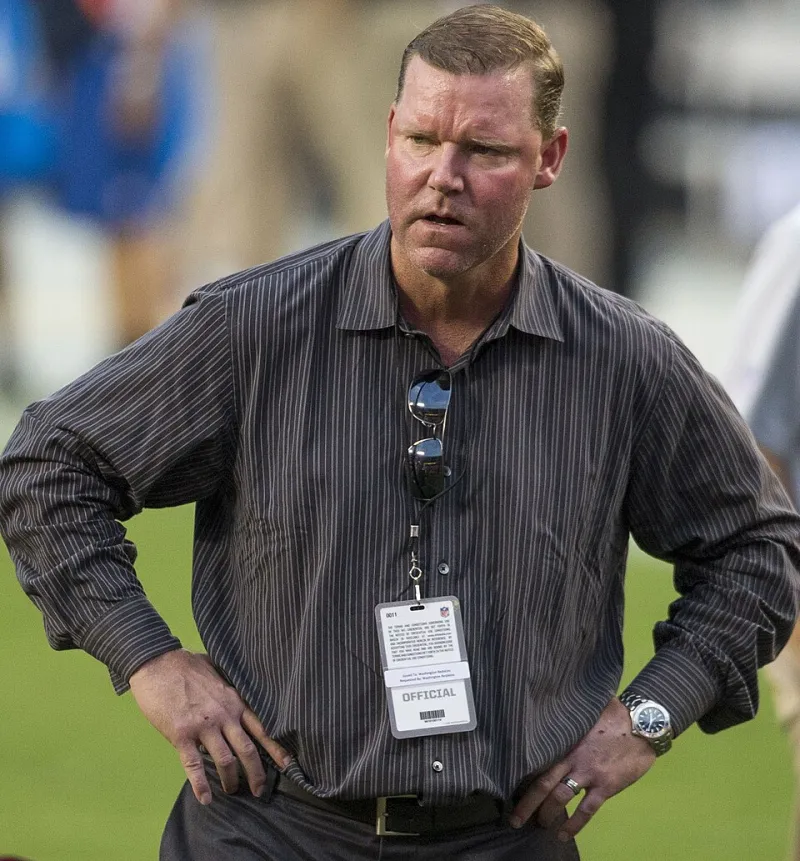
Photo: Orser67 at English Wikipedia, CC BY-SA 3.0, via Wikimedia Commons
Somewhere in an NFL conference room right now, a general manager is staring at a highlight reel from 2021 and convincing himself that the player on screen is still that guy. The injury history? Manageable. The locker room stuff? Overblown. The two seasons of declining production? Just a bad fit. This year will be different.
It won't be. But the check is getting written anyway.
This is the prove-it contract trap, and it's one of the most expensive, most predictable, and most thoroughly ignored problems in professional football. Teams don't fall into it by accident. They fall into it because of a very specific set of organizational pressures that make a questionable veteran signing feel like the safer bet — even when the evidence says otherwise.
Legacy Bias Is a Heck of a Drug
Here's what's actually happening inside these front offices. When a player has been genuinely elite — even for a relatively short window — that reputation calcifies in the minds of evaluators. It becomes the baseline against which all future information gets measured. A bad season becomes an "outlier." An injury becomes "bad luck." A character incident becomes "context-dependent."
Psychologists call this anchoring. In football terms, it means a receiver who caught 90 balls three years ago gets graded on a curve that a younger, cheaper option never would. The veteran's floor is perceived as higher simply because we've seen the ceiling. The rookie's ceiling is theoretical. Theoretical is scary when your job depends on wins.
Ownership pressure makes this worse. Most NFL owners are not patient men. They're not sitting in the owner's box thinking about three-year rebuilds and draft capital efficiency. They're thinking about this season. And when a general manager walks into an ownership meeting and says "we're going with unproven youth at this position," that's a much harder sell than "we brought in a proven veteran who's hungry to bounce back."
Proven. Hungry. Bounce back. These are the three words that have cost NFL franchises hundreds of millions of dollars.
The Math Doesn't Lie, But Teams Ignore It Anyway
Let's talk about what these deals actually look like in practice. A team signs an injury-prone defensive end to a two-year, $22 million contract because he had 12 sacks four years ago and they're convinced the injuries were a fluke. He plays nine games in year one, is a healthy scratch in the playoffs, and is released in year two with $8 million in dead cap still attached to his name.
Meanwhile, the third-round pick they could have developed with that money and those reps is sitting on the practice squad wondering why he can't get on the field.
This isn't a hypothetical. Variations of this story play out across the league every single year. The names change. The positions rotate. The dollar amounts creep higher. But the structure is almost always identical: a team with a real positional need, a veteran with a compelling backstory, and a front office that convinces itself the risk is manageable.
The character-concern version of this trap is arguably even more damaging. At least the injury-prone veteran is usually trying. When a team brings in a player with documented locker room issues or off-field problems because "he just needs the right environment," they're not just gambling on production. They're gambling on culture. And culture, once it gets infected, is remarkably hard to clean up.
The Franchises That Keep Falling for It
You don't need to look hard to identify the repeat offenders. There are organizations around the league with a recognizable pattern: a roster that looks veteran-heavy on paper, draft picks that never developed because they couldn't get snaps, and a salary cap situation that restricts flexibility precisely when flexibility is needed most.
These teams tend to share a few characteristics. They've had ownership-driven urgency that discourages patient building. They've had general managers whose job security is tied to short-term results. And they've had a scouting culture that over-weights past performance relative to current trajectory.
The franchises that avoid the trap — and there are some — tend to have one thing in common: organizational alignment on timeline. When the owner, the GM, and the coaching staff are all operating from the same long-term playbook, the pressure to paper over roster holes with expensive veterans decreases significantly. The draft pick gets the reps. The young player develops. The cap stays clean.
It sounds simple because it is simple. The execution, apparently, is the hard part.
What "Prove It" Really Means
Here's the brutal irony buried inside every one of these signings. The "prove-it" framing is usually applied to the player — he's here to prove he still has it, that the injuries are behind him, that the locker room stuff was a misunderstanding. But the team is the one that should be doing the proving.
Prove you can evaluate talent without being blinded by nostalgia. Prove you can trust your own draft process. Prove you can tell ownership "no" when the short-term solution is the wrong long-term decision.
Until NFL front offices start holding themselves to the same standard they claim to hold their players to, the prove-it contract will keep being the most expensive recurring mistake in the sport. And every March, we'll watch another GM step to the podium and explain — with a completely straight face — why this time is different.